Are you tired of watching more hair collect in your shower drain every morning? You’ve tried the special shampoos. You’ve taken the vitamins. Nothing seems to stop the thinning.
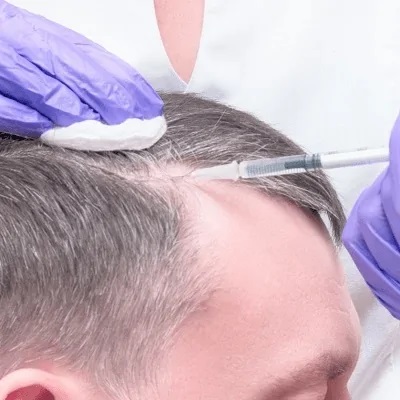
Then you heard about PRP – Platelet-Rich Plasma therapy. The same treatment that celebrities use for facial rejuvenation is now being injected into scalps.
But here’s the question everyone asks but no one answers clearly: Is PRP a permanent solution?
Let me give you the honest answer. No sugar-coating. No sales pitch.
Quick facts:
- Cost starts at 1,500 SAR per session
- Results last 12-18 months
- No downtime
- Non-surgical approach
- Requires maintenance sessions
What is PRP Hair Treatment?
PRP stands for Platelet-Rich Plasma. It is a procedure that uses your own blood to promote hair growth.
A tiny amount of your blood is extracted, just like in a standard blood test. That blood is fed into a centrifuge, which spins it at high speeds.
The spin splits your blood into layers. Red blood cells sink to the bottom. Platelet-rich plasma rises to the surface.
Is PRP Hair Treatment Permanent?
No. PRP hair treatment is not permanent.
The results last 12-18 months for most patients. Then you need maintenance sessions to keep the benefits.
PRP doesn’t change your genetics. If you have male or female pattern baldness, the underlying cause of your hair loss is still there. PRP doesn’t cure that. It just slows it down and stimulates growth.
How Long Do PRP Results Actually Last?
Let me give you a realistic timeline.
| Time After Treatment | What Happens |
| 2-4 weeks | Reduced shedding, subtle improvement |
| 2-3 months | New hair growth visible (fine hairs) |
| 4-6 months | Peak results – thicker, fuller hair |
| 6-9 months | Results begin to slowly fade |
| 9-12 months | Noticeable decline without maintenance |
| 12-18 months | Return to baseline without further treatment |
This is why clinics recommend maintenance sessions every 6-12 months.
How Many Sessions Do You Need?
PRP is not a one-time therapy.
The initial series includes three to four sessions spaced 4-6 weeks apart.
This is the loading phase. It takes many treatments to activate enough growth factors to provide observable results.
Maintenance: 1-2 sessions every year thereafter.
Some people require more regular maintenance if their hair loss is severe. Others can spend a whole year between sessions.
The costs mount up. Consider this while making your selection.
PRP vs Other Hair Loss Treatments – Permanent Comparison
Let me compare your options.
| Treatment | Permanent? | Maintenance Needed | Cost |
| PRP | No | Every 6-12 months | 1,500 – 3,000 SAR/session |
| Minoxidil (Rogaine) | No | Daily, forever | 500 – 1,000 SAR/month |
| Finasteride (Propecia) | No | Daily, forever | 200 – 500 SAR/month |
| Hair Transplant | Yes | None (for transplanted hair) | 20,000 – 50,000 SAR |
| Low-Level Laser | No | Ongoing use | 1,000 – 3,000 SAR device |
Who Is a Good Candidate for PRP?
PRP works best for certain people.
You’re a good candidate if:
- You have early to moderate hair thinning (not completely bald)
- Your hair loss has been occurring for less than 5 years
- You have active hair shedding (not stable baldness)
- You want to slow down or stop further loss
- You’re not ready for surgery
- You’re willing to commit to maintenance sessions
You’re NOT a good candidate if:
- You’re completely bald in the area (no follicles to stimulate)
- You’ve been bald for many years (follicles may be dead)
- You have certain medical conditions (blood disorders, active infections)
- You’re on blood thinners
What Results Can You Actually Expect?
Let me be real with you.
PRP won’t give you a full, thick head of hair if you’re already significantly bald.
What it can do:
- Reduce the amount of hair you shed in the shower
- Thicken existing miniaturized hairs
- Stimulate new growth in thinning areas
- Improve hair quality (shinier, stronger)
- Extend the growth phase of your hair cycle
What it cannot do:
- Regrow hair on completely bald spots
- Change your genetic balding pattern
Why PRP isn’t permanent?
Allow me to explain the biology.
Your hair passes through cycles. There are four phases: growth (anagen), transition (catagen), resting (telogen), and shedding (exogen).
In hereditary baldness, the growth phase becomes increasingly short. Hair spends more time relaxing and shedding. Eventually, follicles shrink and stop generating visible hair.
PRP prolong the growth phase. It produces more anagen hairs at any given moment. That is why you notice increased density.
PRP vs Hair Transplant – Which Is Right for You?
This is the most common question I get.
| Aspect | PRP | Hair Transplant |
| Permanent | No | Yes (transplanted hair) |
| Downtime | None | 7-10 days |
| Cost | Lower upfront, ongoing | Higher upfront, one-time |
| Best for | Early thinning, maintenance | Advanced balding, restoration |
| Works on | Existing follicles | New follicles |
| Results timeline | 4-6 months | 12-18 months |
Here’s the strategy many patients use.
- If you’re in your 20s or early 30s with early thinning, start with PRP. It can buy you 5-10 years before you need a transplant.
- If you’re already significantly bald, get a transplant. Then use PRP to protect your non-transplanted hair from further loss.
Recovery – What to Expect
One of the best things about PRP is the recovery.
Immediately after: Your scalp is red and slightly tender. Tiny bumps at injection sites. You look normal enough to go back to work.
24-48 hours: Redness subsides. You can wash your hair gently. No one can tell you had anything done.
No downtime at all. Resume normal activities immediately.
Book Us Now!
Ready to see if PRP can help your hair? Book a consultation at Aesthetic Clinic Jeddah. We’ll assess your scalp, discuss your goals, and create a personalized plan.
Fill out the form or call us for an appointment.