
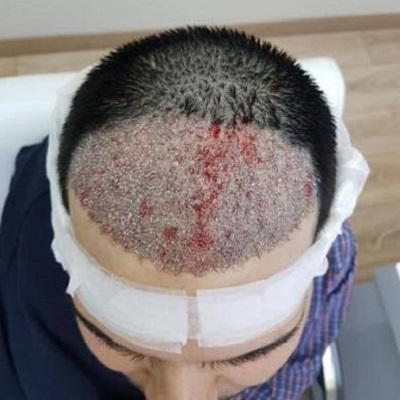
Are you curious about how hair transplants have changed over the years? You’ve probably seen those old photos – the ones that look like someone glued little dolls’ hair onto a bald scalp. That was a hair transplant decades ago.
Thankfully, we’ve come a long way.
Today’s hair transplants are virtually undetectable. You can’t tell who’s had one and who hasn’t. The evolution of this procedure is nothing short of remarkable.
Quick facts:
- Cost starts at 29,999 SAR
- Long-lasting results
- Minimal downtime
- Surgical approach
- Temporary side effects
What is a Hair Transplant?
A hair transplant is a treatment in which a surgeon transfers healthy hair follicles from the back and sides of your head (the “donor area”) to the balding or thinning areas on top.
The hair on the back and sides is genetically resistant to baldness. Once moved, it remains in that position. Forever.
That is the beauty of it. Unlike drugs, a hair transplant is permanent.
But it hasn’t always appeared permanent in a positive sense. Let me describe how we got from there to here.
How has hair transplantation improved through evolution?
The Early Days
Let me paint you a picture of how hair transplants started.
In the 1950s, a New York dermatologist named Dr. Norman Orentreich made a groundbreaking discovery. He found that hair follicles from the back of the head retained their genetic resistance to balding even when moved to the front. This was called “donor dominance.”
Surgeons used large, round punches – think of a hole punch you’d use for paper – to remove plugs of skin containing 10-20 hairs each. They then punched matching holes in the balding area and inserted the plugs.
The result looked exactly like what it was: plugs. Row after row of unnatural, doll-like hair tufts. Patients looked like they had hair growing in cornfields. The spaces between the plugs were still bald.
Why it failed:
- Large grafts looked unnatural
- Obvious spacing between grafts
- Hair grew in the wrong direction
- Scarring was significant
The Mini-Graft Era (1980s-1990s)
Surgeons realized the problem: grafts were too big. So they started making them smaller.
Mini-grafts contained 4-8 hairs. Micro-grafts contained 1-3 hairs. This was progress. The results looked better – not great, but better.
Instead of cornrows, patients had a more natural hairline. You could still tell something was done, but it wasn’t as obvious.
What improved:
- Grafts became smaller
- Hairs could be placed more naturally
- Hairs could follow natural growth direction
The FUT Era: Strip Harvesting (1990s-2010s)
Follicular Unit Transplantation (FUT) became the gold standard for decades.
A strip of skin was taken from the back of the skull. Under a microscope, technicians divided the strip into individual follicular units (natural groups of 1-4 hairs). The physician next made small incisions in the balding region to put the transplants.
Benefits:
- Surgeons might harvest several grafts in one session (3,000 to 5,000+).
- When executed correctly, the results appeared natural.
- Cost-effective for patients who require many grafts.
The FUE Revolution (2000s-Present)
Then came FUE – Follicular Unit Extraction. And everything changed.
Instead of cutting a strip of skin, surgeons use a tiny punch tool (0.7-0.9mm) to extract individual follicles directly from the donor area. There’s no linear scar. Just tiny dot-like scars that are virtually invisible, even with very short hair.
What made FUE revolutionary:
- No linear scar. You can shave your head. You can wear your hair at any length. No one will know.
- Less pain. Smaller wounds heal faster. Patients report significantly less post-op discomfort.
- Faster recovery. Back to work in 5-7 days instead of 2-3 weeks.
- More natural results. Surgeons can carefully select the best follicles and place them with precision.
- Can harvest from body hair. Beard, chest, leg hair can be used if scalp donor is limited.
The Robotic Era (2010s–present)
Then robots joined the chat.
The ARTAS robotic system uses artificial intelligence (AI) and computer vision to locate the healthiest follicles, determine the best angle for extraction, and guide the surgeon’s hand.
Benefits of Robotic FUE:
- Reduced human error.
- Graft survival rates are higher (99% vs to 90-95% manual)
- Less transection (follicle damage caused during extraction)
- Consistent quality throughout thousands of grafts
The DHI:
DHI (Direct Hair Implantation) took FUE one step further.
Instead of extracting all grafts first, then making incisions, then placing them – DHI does everything in one step. The surgeon extracts a follicle, loads it into a specialized Choi implanter pen, and immediately implants it into the recipient site.
Why DHI matters:
- No waiting time between extraction and implantation (grafts are fresher)
- Complete control over angle, depth, and direction
- Higher density possible in one session
- Faster healing (smaller incisions)
What About Scarring?
| Era | Scar Type | Visibility |
| Plugs (1950s-80s) | Large circular scars in recipient area | Very obvious |
| Mini-grafts (80s-90s) | Linear donor scar + cobblestoning | Noticeable |
| FUT (90s-2010s) | Linear donor scar (ear to ear) | Hidden by longer hair |
| FUE (2010s-present) | Tiny dot scars in donor area | Invisible even with short hair |
| DHI (present) | Even smaller dot scars | Truly undetectable |
Pain Reduction Through Evolution
Old transplants were painful. The strip removal left a large wound. The recovery was long and uncomfortable.
Today’s FUE and DHI procedures are performed under local anesthesia. You’re awake but completely numb. Patients describe the sensation as pressure, tugging, or mild discomfort – not pain.
Pain levels through the eras:
| Era | During Procedure | Recovery Pain (0-10) |
| Plugs | Significant | 7-8 |
| Mini-grafts | Moderate | 5-6 |
| FUT | Mild (with anesthesia) | 4-5 |
| FUE | Mild (with anesthesia) | 2-3 |
| DHI | Minimal | 1-2 |
Recovery Time Through Evolution
- Old transplants: 2-4 weeks before returning to normal activities. Stitches. Visible scarring. Weeks of hiding.
- FUT: 2 weeks before returning to work. 4 weeks before exercise. Linear scar requires longer hair to cover.
- FUE: 5-7 days before returning to work. 2-3 weeks before exercise. No visible scarring.
- DHI: 3-5 days before returning to work. 2 weeks before exercise. Virtually no scarring.
The evolution has made hair transplantation accessible to people who can’t take months off work.
Book Us Now!
Ready to get a hair transplant that no one will ever detect? Book now at Aesthetic Clinic Jeddah. Our surgeons perform FUE and DHI transplants with natural-looking results.
Fill out the form or call us for an appointment.